Guide to buying a retractable folding arm awning

A retractable “folding arm” awning is one of the simplest ways to create controllable sun shade, small, medium or large in size, protect adjoining rooms from heat and enjoy your outdoor space more often. Before you order, there are a few key decisions to work through: where the awning can safely be fixed, what size you really need, and which model, cassette style and operation will suit your home and lifestyle.
Start by being clear on what you want the awning to do day to day.
Your main purpose will influence the size, projection, fabric and model you choose, and whether you prioritise shading the door/window glass or covering furniture.
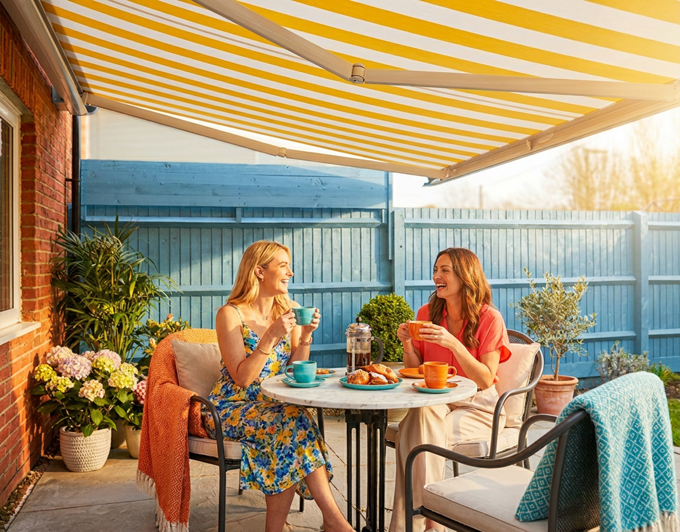
Before looking at awning models, check that the wall or structure you’re planning to use is suitable. This avoids choosing an awning that can’t be safely installed.
Brickwork and structure
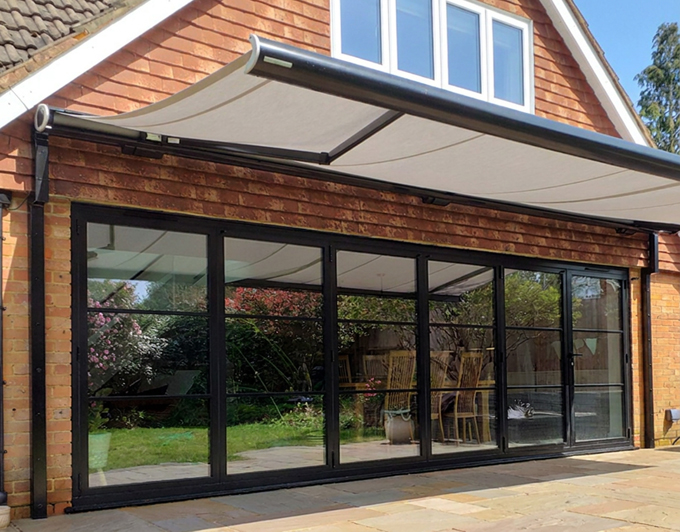
If your wall is rendered, it’s worth knowing what’s behind the render (solid brick, blockwork, timber frame) so the installer can choose the right fixings.
There is no exact science to this without exact details of original wall build and load capabilities from a building expert, so many people should and do tend to adopt a ‘belt and braces’ type approach with any awning of a reasonable size. Use chemfix for the brackets, order larger brackets when there is any doubt on the integrity of the wall and always order vertical spreader brackets for single storey buildings. Or gutter brackets if you need more height for the awning.
For more detailed information on bracket options, see our Guide to Special Brackets.
Obstacles and clearance
Look carefully for anything the awning or brackets must avoid: downpipes, external lights, vents, alarm boxes or cables.
Our “How to Measure for a Retractable Awning” guide provides diagrams and tips covering width, projection, mounting height and pitch.
Getting the size right is where most buyers need the most help. Width and projection determine how well the awning will shade your room and outdoor furniture.
Width
As a rule, your awning width should be at least slightly wider than the window or door opening you’re shading.
If your patio is very wide, you can either partially cover the main seating area with one awning or use two awnings to cover a larger space.
Remember with any folding arm awning the fabric cover is ALWAYS narrower than the actual awning ordering width and this varies from model to model.
You will usually find the fabric is about 70mm either side narrower, so a 5000mm wide awning might have a 4860mm wide fabric cover.
Projection (how far it comes out)
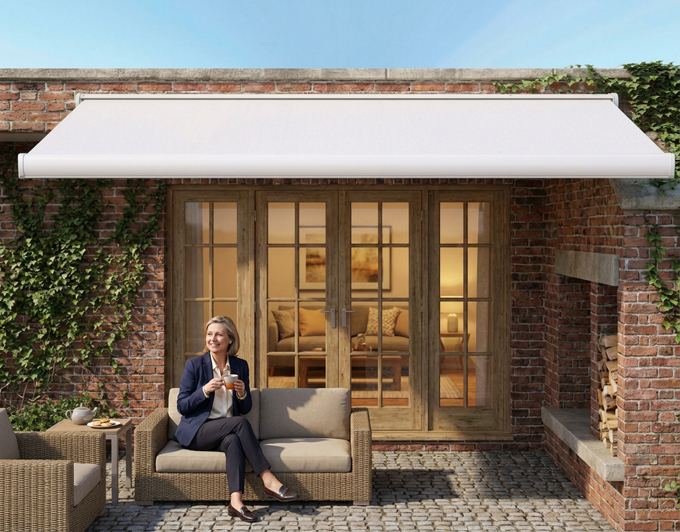
Projection determines how much usable shaded area you’ll have.
Think in practical terms: mark out your furniture on the patio and imagine the front edge of the awning 2.5 m or 3 m above it, then decide what feels right. Use a straight piece of timber and hold it against the wall as high as you can at an angle and see where the shade appears on the floor. You might be surprised
Our most popular sizes
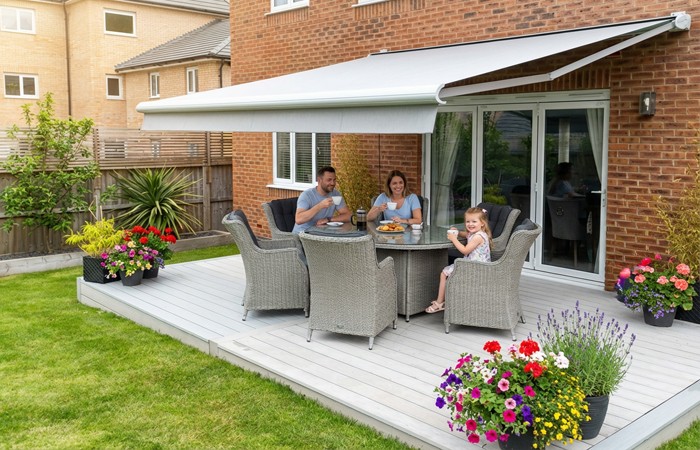
On Awnings Online, our most popular retractable awnings are between 4.5 m and 5.5 m wide with a 2.5 m - 3.6 m projection. These sizes work particularly well across large patio or bi‑fold door openings and provide a generous, flexible shaded area for typical UK gardens.
In nearly two decades of selling awnings, customers far more often wish they’d gone a little larger than regret choosing a more generous size. Remember: with any retractable awning you can stop it at any point during extension, so a larger unit still gives you fine control over shade throughout the day.
Where the sun comes from and how it moves across your garden is just as important as the raw measurements.
Garden orientation
Awnings create angled shade rather than acting as a solid roof, so the exact position and angle will affect how far the shadow reaches at different times.
Mounting height and pitch
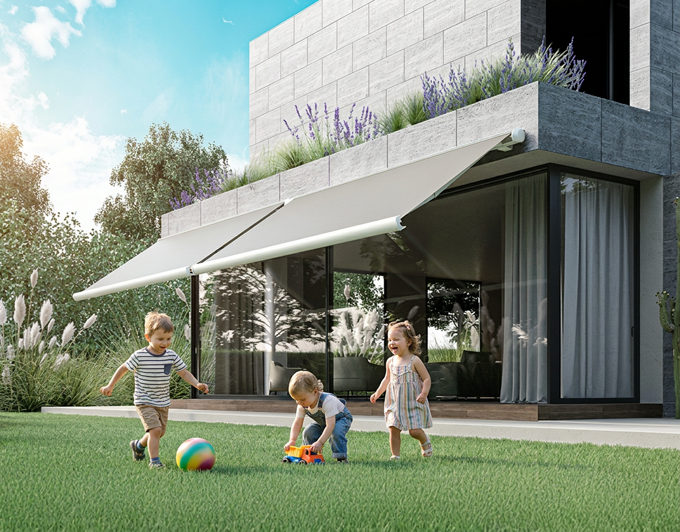
The lower front edge should still be comfortable to walk under, even with this pitch, so it’s worth thinking about head height clearance when you plan your fixing height.
Once you know the size and where the awning can fix, you can narrow down the type of cassette – how much of the mechanism and fabric is enclosed when the awning is retracted.
Most people think they automatically want a full cassette awning, but that isn’t necessarily the right or best choice or even required
Full cassette awnings
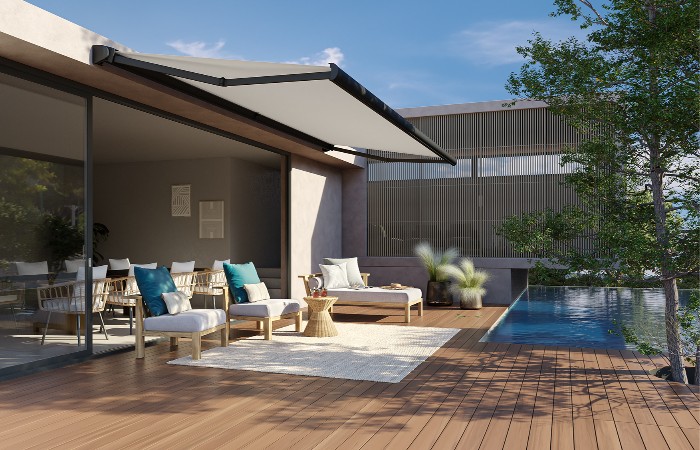
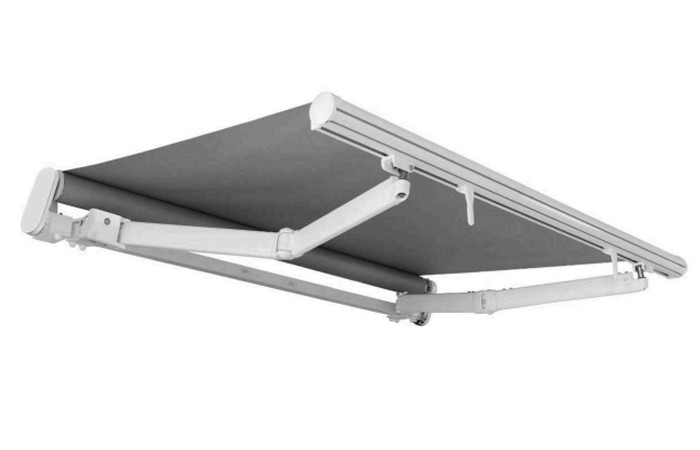
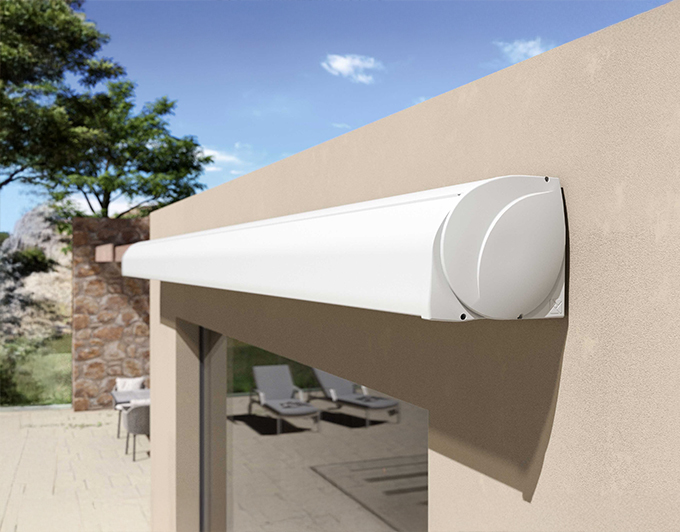
Full cassette awnings retract the arms and fabric completely into an aluminium cassette housing, protecting them from weather and dirt when closed. You will see many variations on the shape of these - square, rectangular, oval, round and so on and this may be relevant to your house style for sure.
Many full cassette designs are “end‑fix” awnings, meaning the main brackets sit close to the arms at each end of the cassette rather than on a central torque bar. This is perfect for solid walls with clear space at each end, or where there might be a large doorway to cover with ni fixing points above ad along the length of the aperture.
Semi cassette awnings
Semi cassette awnings partially enclose the fabric and components, often leaving some of the arms exposed when closed.
For many domestic patios, a high quality semi cassette model offers more than enough protection, especially in less exposed locations and is often a stronger overall installation.
Open cassette awnings
Open cassette awnings leave the roller and arms visible, but can be supplied with aluminium hood covers to protect the fabric from rainfall when retracted. They are typically used more in commercial applications because of their lighter weight and multiple fixing points.
The right option depends on your wall, exposure, budget and design preference. For larger sizes, it’s worth comparing several models in each category.
Understanding how the awning is supported on the wall helps you pick a model that suits your fixing position.
If your wall has limited solid fixing points or multiple interruptions, a torque‑bar semi or open cassette model with variable bracket positions can be the more practical and safer choice.
Next, decide how you want to operate your awning.
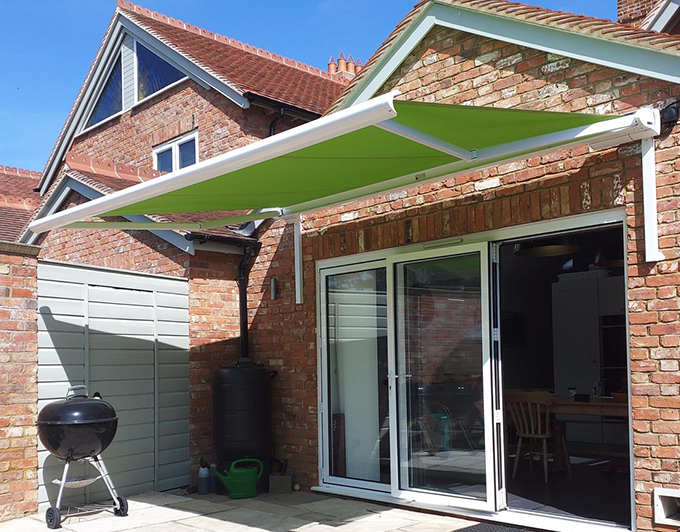
Electric awnings
Electric operation makes it effortless to use the awning as part of your daily routine. As it is just the push of a button it is easier to constantly adjust during the day time and with the sun moving around.
Weather sensors are a genuine safety and convenience benefit, helping protect the awning if the weather turns while you’re busy or away from home. The wind or motion sensor will always override all other sensors to protect the awning.
Manual awnings
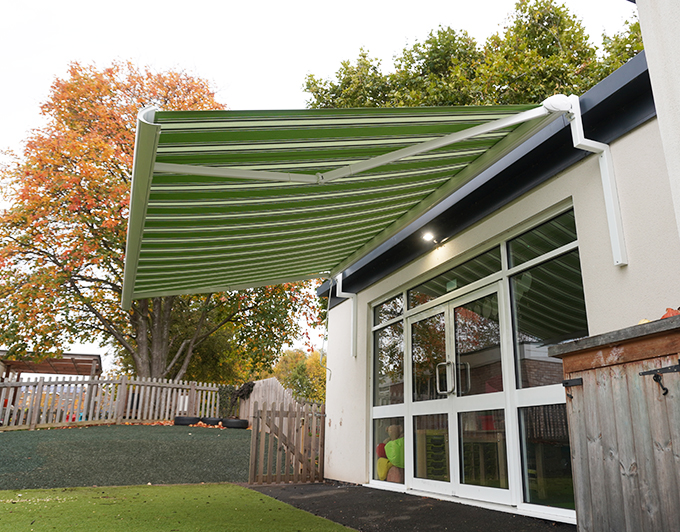
Manual operation uses a crank winding handle to extend and retract the awning.
Both options give the exact same shade when extended; the difference is how effortless you want everyday use to feel and whether you want the additional protection of automatic sensors and sensors to help control the sun and heat automatically.
The fabric is the most visible part of your awning and plays a big role in comfort, heat and longevity.
Performance and technology
High quality external awning fabrics are designed for:
Water resistant, breathable fabrics are ideal for folding arm awnings; fully waterproof is not necessary as you do not want sitting on the fabric or stressing the arms and brackets at anytime.
Colour and orientation
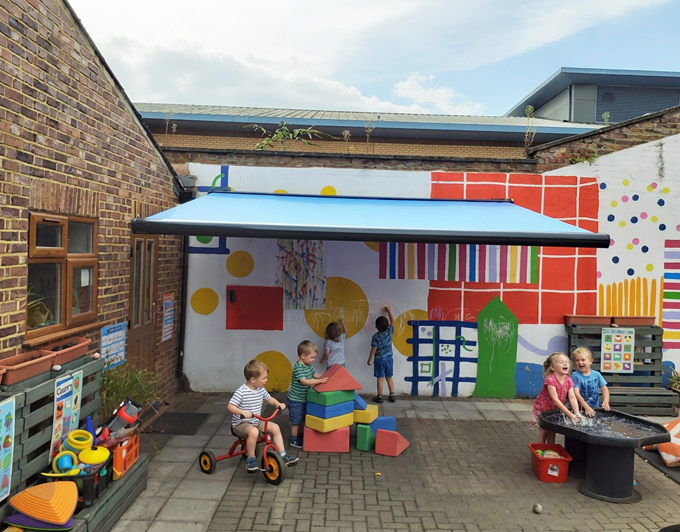
With hundreds of solids, stripes, textures and blocks available, the “best” fabric is the one that suits your home and how you use the space.
Textured and striped fabrics can also reduce perceived glare compared with very flat, light solids, while adding visual interest to the façade.
There are usually extended technical details available for any of the fabrics so you can assess their UV value and other performance data.
A common question is whether a retractable awning can be used in rain or wind. It’s important to set the right expectations from the outset. Whilst most high quality awnings have a tested wind class rating this is at a certain size and in controlled test conditions. In real world use, steady vs. buffeting wind conditions can make a huge difference and most awnings are in fact tested to wind speeds where you wouldn’t want to be sitting outside anyway. The larger the awning the more it will catch the wind, just like a kit or sail would. If you want a very large awning and you know it is windy where you are then maybe look at a retractable fabric pergola system instead for the better stability and performance.
Think of the awning as an adjustable shade canopy with occasional light rain use, not as a permanent storm cover.
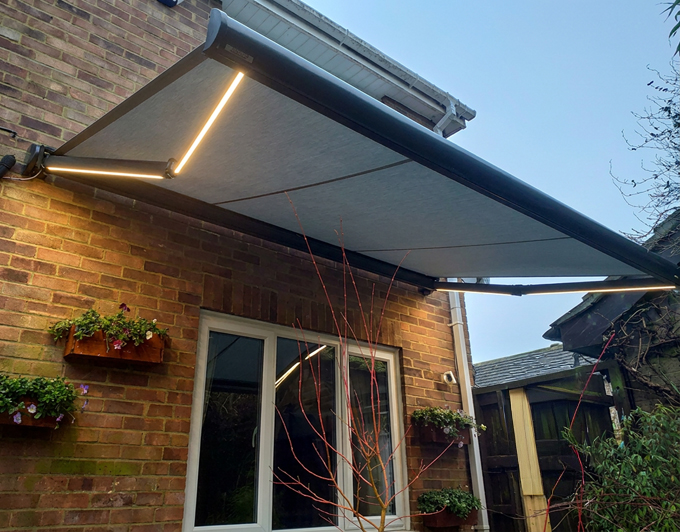
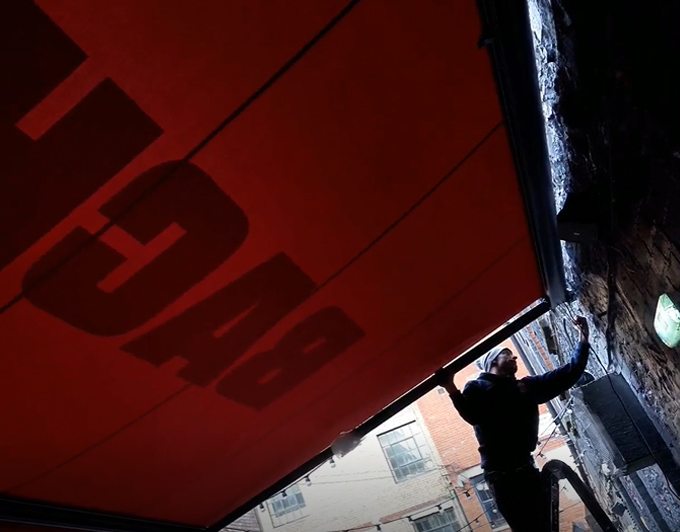
Retractable awnings are substantial products that must be installed correctly for safety and long term performance.
If you’re unsure whether your wall is suitable, it helps to send in photos and basic measurements. Experienced installers can quickly advise on bracket options or whether an alternative product is better suited.
Awnings Online can help you with professional installers and surveyors, so if you are thinking you don't want to get involved at all then send us photos of your proposed area and ideas and we can recommend the best potential awning model and provide independent installer details for you.
To recap, here’s a simple checklist to run through before placing your order: